
$189.00 Original price was: $189.00.$170.00Current price is: $170.00.Save $19.00
What’s Included: 5 Vials
Research Note: Oxytocin should not be mixed in the same solution with other compounds due to pH incompatibility.
Form: Lyophilized Powder
Purity: ≥ 99% USA Tested, Verified Purity (HPLC Tested)
Verification: Verifiable COA’s (Batch-Matched)
Emerging Research Evidence:
Emerging research explores how these peptides interact with neurochemical signaling pathways involved in stress-response modulation, affective processing, and cognitive signaling stability. Ongoing laboratory studies examine associations with immune signaling balance, inflammatory tone, social cognition markers, and adaptive stress-response pathways within controlled experimental models.
Keep product in cool, dark place.
Sold for Research Use Only / Not FDA Regulated
Batch-verified inventory. See Individual Products for 3rd Party COA’s
In stock
⚠️ Requires Sterile Water for Reconstitution
For laboratory use only.
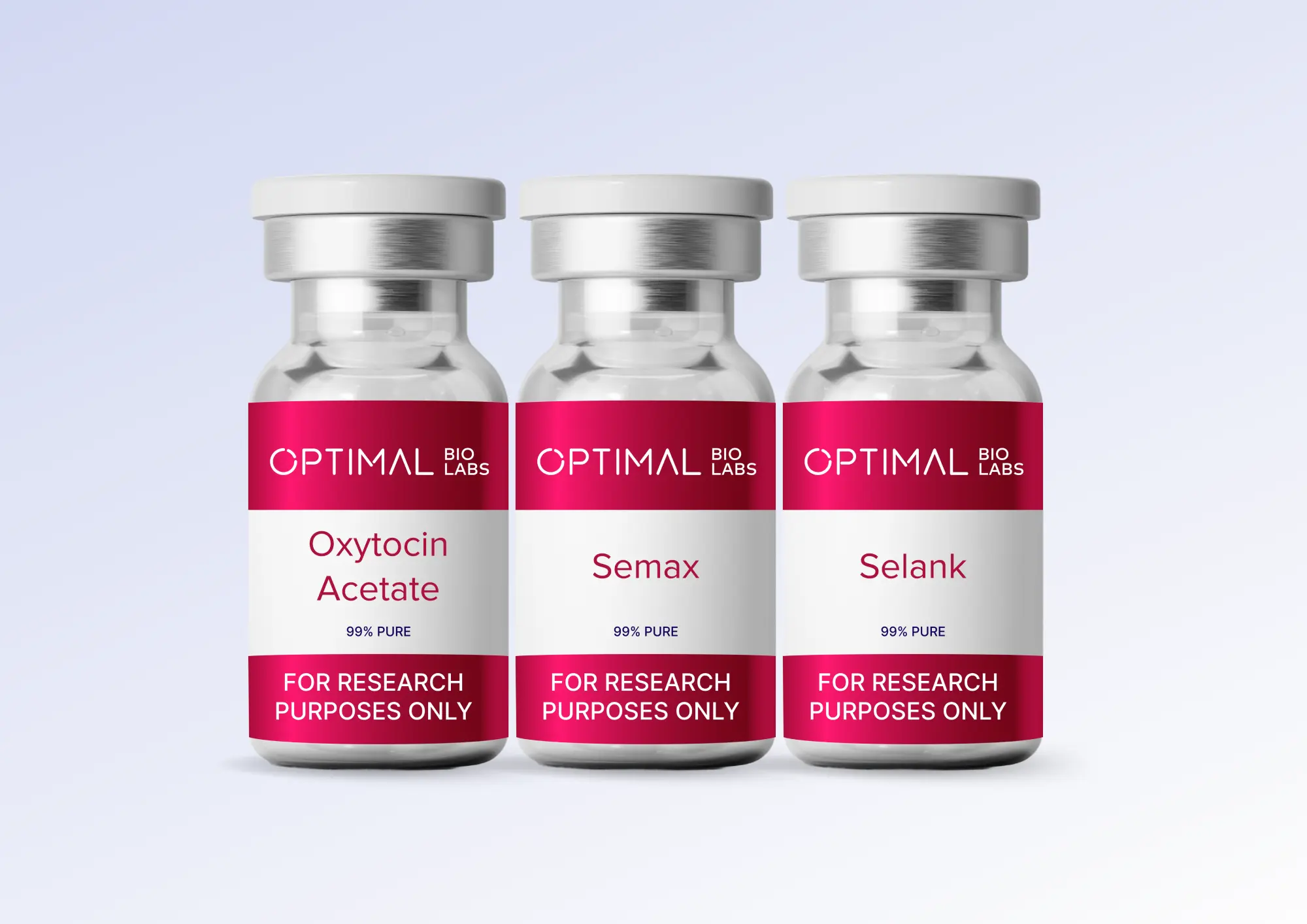
Stress & Mood Regulation Research Collection Overview
This research collection combines Selank, Semax, and Oxytocin Acetate to support laboratory investigation into complex neurochemical and physiological signaling systems. Researchers utilize this collection to examine GABAergic modulation, ACTH-fragment–related signaling, and oxytocin-receptor activity associated with stress-response and social cognition models.
By integrating these peptides into a single experimental framework, the collection enables structured study of neuroprotective pathways, immune signaling interactions, and cognitive processing markers within controlled research environments.
Why these three together? “Synergy: combine mood regulation + cognitive clarity + social-affective resilience to interrogate multiple facets of stress and anxiety markers in one collection.”
Selank: studied for GABAergic and immunomodulatory effects linked to calm, focus, and balanced mood.
Semax: explored for attention, memory, and neurocognitive performance under research conditions.
Oxytocin: investigated for social-cognition endpoints and modulation of stress perception.
This collection is curated to help investigators examine complementary pathways that literature associates with:
Stress-response signaling — examine GABAergic and neuropeptide-linked pathways associated with adaptive stress models.
Attention, learning & memory (Attention-deficit models) — evaluate focus, working memory, and learning metrics.
Cognitive processing & executive signaling — study alertness, information processing, and attentional control markers.
Immune support & anti-inflammatory tone — explore immunomodulatory balance and inflammation markers.
In laboratory settings, Selank is investigated for its potential influence on anxiety models and cognitive signaling pathways, specifically regarding memory and learning. As a synthetic analogue of the naturally occurring peptide tuftsin, researchers study its action as a modulator of GABAergic neurotransmission, distinct from the mechanisms of benzodiazepines, to evaluate stress-response properties and stress-response markers without the presence of sedative indicators. Preclinical research explores its potential neuroprotective benefits and its influence on immune system signaling, with ongoing studies examining its effects on behavioral aggression models and stress adaptation in controlled environments.
Semax is a peptide derived from a fragment of adrenocorticotropic hormone (ACTH) and is studied in research models for its potential to support neuronal resilience and cognitive performance. In preclinical evaluation, the compound is investigated for its neuroprotective effects and its relationship to learning and memory retention pathways. Current laboratory research also explores the peptide’s role in attention models and physiological stress response systems. Studies further investigate its potential application in models of neurological challenge, including circulatory support mechanisms and neurotrophic factor expression.
Oxytocin Acetate is the synthetic salt form of a nine-amino-acid neuropeptide investigated for its role as an agonist at the oxytocin receptor (OXTR) within social cognition and bonding models. While research often centers on its peripheral effects in lactation signaling, scientific interest also focuses on its central influence on fear conditioning and stress adaptation in animal models. Furthermore, researchers utilize Oxytocin Acetate to study metabolic homeostasis and cardiovascular regulation. It is frequently evaluated as a molecule for stress-coping research, with studies documenting its potential anti-inflammatory and antioxidant properties within various trauma and adversity models.
Research-only note: These compounds are not FDA-approved for therapeutic use; published effects are primarily preclinical and exploratory.
For Research Use Only — Not for Human or Veterinary Use. Not evaluated or approved by the FDA. Not intended to diagnose, treat, cure, or prevent any disease. All information on this website is provided strictly for laboratory research and educational purposes. Nothing herein constitutes medical, clinical, or legal advice, nor an endorsement of non-laboratory use. Any discussion of specific peptides or potential research findings is informational only and must not be interpreted as guidance for use in or on humans or animals.