
$251.00 Original price was: $251.00.$213.35Current price is: $213.35.Save $37.65
What’s Included: 6 Compound Vials
Research Duration: Approximately 2–4 weeks depending on protocol. GHRP-6 and IGF-1 LR3 are aligned in duration; CJC-1295 + Ipamorelin may extend longer.
Research Note: Due to pH sensitivity and stability, IGF-1 LR3 is commonly handled separately in laboratory preparation workflows.
Form: Lyophilized Powder
Emerging Research Evidence:
Researched for muscle growth, lean tissue, protein synthesis, and performance-related signaling pathways.
Batch-verified inventory. See Individual Products for 3rd Party COA’s
Keep products in cool, dark place. Once mixed, keep refrigerated.
Sold for Research Use Only / Not FDA Regulated.
In Stock — Order by 3 PM Central Time, ships today
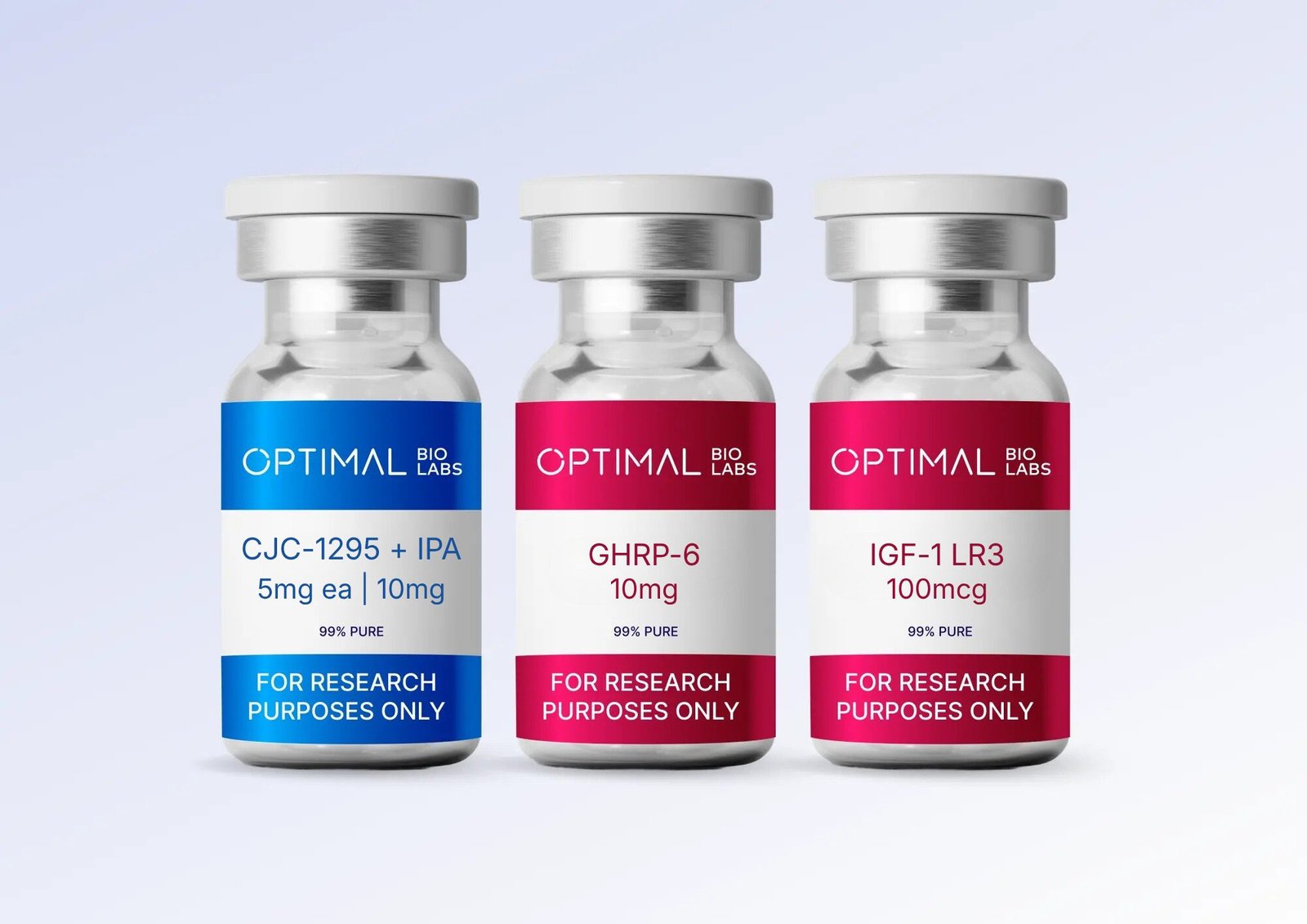
This research collection is designed for investigators studying how coordinated signaling pathways influence lean tissue development, metabolic activity, and performance-related biological markers in controlled laboratory environments.
The combination brings together upstream signaling compounds with downstream growth-related pathways, allowing researchers to observe how these systems interact across multiple levels. Current areas of study focus on protein synthesis signaling, cellular growth pathways, and the regulation of metabolic processes tied to tissue composition and energy utilization.
Researchers commonly use this type of framework to examine measurable biological markers associated with structural development, nutrient partitioning, and adaptive responses within experimental models.
This type of multi-pathway collection is commonly used to study how signaling cascades interact, particularly in models examining the relationship between initial pathway activation and downstream cellular response. Ongoing research continues to explore how these interactions influence measurable biological markers across different experimental conditions.
CJC-1295 with Ipamorelin is a synergistic research combination investigated for its dual-action modulation of endogenous growth hormone signaling. In laboratory settings, CJC-1295 is studied for its ability to provide sustained signaling activity, while Ipamorelin acts as a selective agonist to trigger controlled, pulsatile pathway activation through the ghrelin receptor. Researchers utilize this pairing to observe biological markers associated with protein synthesis signaling, metabolic regulation, and lean tissue–associated biomarkers. This combination is also used to evaluate signaling patterns that reflect natural physiological pulse dynamics within controlled experimental models.
GHRP-6 is a growth hormone–releasing peptide widely studied for its role in stimulating signaling pathways associated with endogenous growth hormone activity. In laboratory research, it is investigated for its ability to activate the ghrelin receptor, contributing to measurable changes in downstream signaling markers. Researchers commonly examine GHRP-6 in relation to protein synthesis–associated biomarkers, metabolic signaling, and nutrient utilization pathways. Additional areas of study include its influence on appetite-related signaling, energy balance markers, and adaptive response indicators within controlled experimental environments.
IGF-1 LR3 is a long-acting analogue of insulin-like growth factor-1 (IGF-1), extensively studied for its role in cellular growth signaling and protein synthesis–related pathways. In research settings, it is utilized to investigate downstream signaling activity associated with cellular development, structural integrity markers, and tissue-level growth dynamics. Scientific literature frequently explores its involvement in pathways linked to nutrient partitioning, metabolic efficiency, and the regulation of growth-related biomarkers. Ongoing studies continue to examine how IGF-1 LR3 interacts with upstream signaling compounds to influence measurable cellular responses in controlled laboratory models.
These compounds are not FDA-approved for therapeutic use. Published findings are primarily preclinical and exploratory, and all materials are intended for research use only.
For Research Use Only — Not for Human or Veterinary Use. Not evaluated or approved by the FDA. Not intended to diagnose, treat, cure, or prevent any disease. All information on this website is provided strictly for laboratory research and educational purposes. Nothing herein constitutes medical, clinical, or legal advice, nor an endorsement of non-laboratory use. Any discussion of specific peptides or potential research findings is informational only and must not be interpreted as guidance for use in or on humans or animals.
Website information, calculators, guides, and educational resources are provided for general informational purposes only. They are not intended for human or veterinary use, medical advice, dosing, administration, treatment, or promised outcomes.
Tengo 21 años o más y entiendo que este sitio, sus productos y recursos son solo para fines de investigación e información, no para uso humano o veterinario ni como asesoramiento médico.